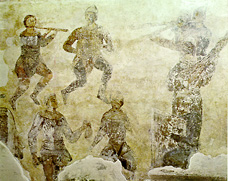
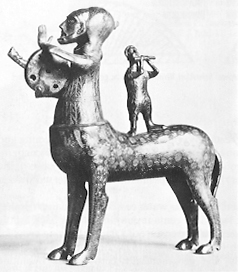
| A wall painting at Hagia Sohia,
Kiev, showing a group of acrobats of the Imperial Byzantine Circus playing
flute, trumpets or shawms, lute, psaltery, and cymbals. |
The main instruments for performing art
music in the early middle ages were bowed and plucked strings: fiddle, rebec,
harp, psaltery, and gittern. The transverse flute appears only occasionally
along with other instruments such as portative organ and hurdy-gurdy. It
seems to have been known only in the Holy Roman Empire, or the lands loosely
known as Germany. This is probably the source of the names flûte d'Allemagne
and 'German flute' for the transverse instrument. |