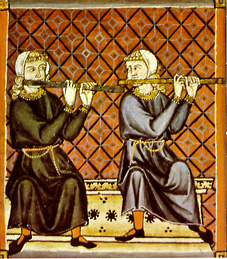
| A transverse flute is shown in an ensemble
with harp, fiddle, and rote in an illustration in Rudolf von Ems's Weltchronik
(c1255-70). The same combination of instruments occurs in Ulrich von Türheim's
Der starke Rennewart (c1300), so perhaps such an ensemble really existed
in Austrian and Bavarian aristocratic circles in the 13th century.
|
|
|
A French literary set-piece,
Cleomadés (c1285), by Adenet le Roi, lists the musical instruments
owned by a famous minstrel. Adenet, himself the chief minstrel at the court
of Gui de Damperre, Count of Flanders, gives the first unmistakable literary
reference to transverse flutes, as Flahutes d'argent traversaines,
or, literally 'silver transverse flutes'. |
