| 1300 |
1310 |
1320 |
1330 |
1340 |
1350 |
1360 |
1370 |
1380 |
1390 |
| Fourteenth-century pictures and literary
references in France and Germany compare the sound of the flute to the trombone
and trumpet. Pictures show transverse flutes being played outdoors by soldiers
together with large bells, drums, bagpipes and trumpets. |
 |
|
|
Transverse flutes appear rather frequently
in the hands of angels in illuminated manuscripts made in Bourges and Paris
around the turn of the 15th century. But they seem to have remained
familiar only in Germany and France, while unknown in other countries such
as Italy. |
| |
|
|
The poet/composer Guillaume de Machaut
made a distinction between transverse flutes and recorders or other duct
flutes, and Eustache Deschamps suggested that the flute led a double life
as a soft, indoor instrument, as well as a loud one with military connotations.
|
|
| |
|
|
|
|
|
| |
|
|
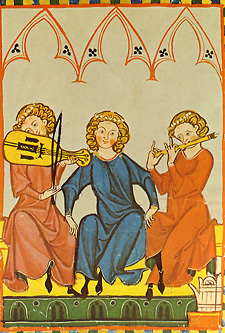
A miniature containing 54 songs by the Minnesinger
Johannes Hadlaub shows a 4-stringed fiddler and a transverse flute player
holding the instrument to his right, accompanying a singer seated between
them. The music in the manuscript is monophonic, but perhaps the instruments
doubled the vocal line, or played drones or improvised other parts. |
|
|
|
|
|
|
