1500 1510 1520 1530 1540 1550 1560 1570 1580 1590
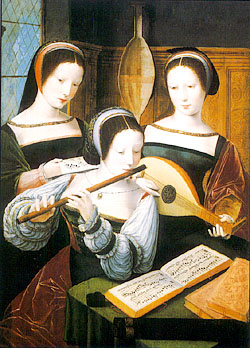
Copies of this picture, in which a flutist, singer, and lutenist play from a part-book containing Claudin's chanson 'Jouissance vous donneray', survive in Vienna, St Petersburg, and Meiningen. In some the flutist plays the superius part, in others the tenor.
Pierre Attaingnant publishes two collections containing 58 Chansons in four parts (1533) in Paris. He designates some as suitable for flutes, some for recorders, and some for both. More commonly, publications leave the choice of instruments to the players. Mixed consorts including flutes first appear in sacred compositions at the Bavarian court in Munich under Orlando di Lasso's direction. Munich musicians soon take these ideas to Venice.  
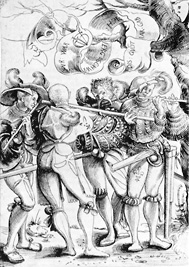
  By the late 16th century military instruments are sometimes differentiated from indoor flutes. Here four soldiers play consort music.   The first printed solo pieces for transverse flute survive from the end of the 16th century and the beginning of the 17th. Aurelio Virgiliano's Il Dolcimelo, book 2 (c1600) contains Ricercate in the Italian division style for cornetto, violin, traversa or other instruments.


The flute was made in several sizes in the 16th century. The consort consisted of three sizes of instrument pitched a 5th apart: a bass with a lowest note of G, a tenor/alto with a lowest note of D, and a discant with a lowest note of A. The commonest consort had a bass and three tenor/altos .By the early 16th century, ensembles of flutes had become a favorite for playing the 4-part consort repertoire of that period. Courts in England, Hungary, Madrid, and Stuttgart each owned dozens or even hundreds of transverse flutes. Renaissance flute page   Hexachords and the Renaissance flute