Military flute page

A new flute in three sections, designed for solo playing, emerges in
France.
Baroque flute page
P.J. Bressan (London) makes a three-joint flute by c1690.
| 1600 | 1610 | 1620 | 1630 | 1640 | 1650 | 1660 | 1670 | 1680 | 1690 |
|---|---|---|---|---|---|---|---|---|---|
| Mixed consorts in Vienna, Florence, England, and Germany sometimes use a D flute on the tenor part together with all sorts of other instruments: viols, lutes, cittern, bandora, harpsichord, muted trombone, viola bastarda, discant fiddle, and dulcian. | |
Michael Praetorius (Wolfenbüttel) and Heinrich Schütz (Dresden) are among the composers writing pieces for multiple choirs of voices and instruments, sometimes specifying groups of flutes to contrast with viols, trombones, crumhorns, recorders, and other instruments. | Marin Mersenne's Harmonie Universelle (1636) gives a four-part Air as an example of music for a flute consort. | Flutes begin appearing in French and German opera and chamber music in the 1680s. Jean-Baptiste Lully's opera-ballet Le Triomphe de l'Amour (1681) first specifies Flûtes d'Allemagne. | |||||
| Jacob van Eyck's three-part collection of diminution-variations on popular tunes, Der Fluyten Lust-hof (Amsterdam, 1646), specifies a discant flute in G as an alternative to a recorder at the same pitch. | Philbert Rebillé and René Pignon Descoteaux. the latter known as a fine singer, become famous at the French court for their moving interpretations on the flute of the delicate pastoral songs fashionable at the time. | ||||||||
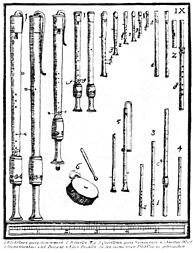
| Recorders (on the left) and flutes (lower right) from Michael Praetorius's Syntagma Musicum (1619). | |||||||||
| Flutes, now sometimes referred to as 'fifes'
remain in use with drums in military and ceremonial music of England, Italy,
France, and Germany. Military flute page |
|||||||||
|
A new flute in three sections, designed for solo playing, emerges in
France. |
P.J. Bressan (London) makes a three-joint flute by c1690. |
||||||||