| 1700 |
1710 |
1720 |
1730 |
1740 |
1750 |
1760 |
1770 |
1780 |
1790 |
| The flute starts to become popular as
a solo instrument and to acquire its own repertoire with Michel de Labarre's
Pieces pour la flûte traversière avec la basse-continue (1702). |
 |
A booming market for instruments and
music provides opportunities for makers, composers, teachers, and publishers
in England, France, Holland, and Germany. |
|
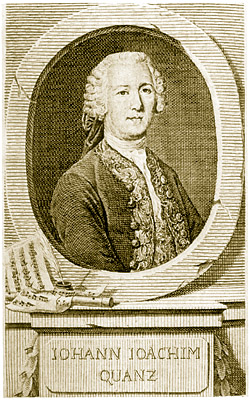 |
Quantz's
Essay of a Method of Playing the Flute traversiere, a massive treatise
on performance practice, is published in German and French in 1752. |
|
The blind child prodigy Friedrich Ludwig Dülon begins
a famous career as a touring virtuoso (1779). |
 |
|
| Professional flutists nearly
all play oboe as their first instrument. In England they appear before a
paying audience in public concerts, alongside players of the violin, oboe,
recorder, and keyboard. Their repertoire includes new forms such as solos
(sonatas or suites for flute and basso continuo) and concertos. Concerts
in France and Germany are still mostly private affairs. |
|
The printing of opera arrangements
and other music in easy keys for amateurs increases. Meanwhile Dresden
flute virtuosi write challenging music in a range of difficult keys.
Flutes become a more regular feature of opera scores, and the Italian operatic
style dominates flute music. |
Larger-scale instrumental music such as
the symphony becomes fashionable in the mid-18th century. Instrumentalists
develop distinctive styles of playing, and groups of music-lovers in various
cities provide opportunities for flute soloists to make concert tours. |
|
François Devienne and Antoine Hugot are
among 5 professors of flute at the new Paris Conservatoire. |
| |
Solo concertos and chamber works by classical
composers including Mozart, J.C. Bach, F. A. Hoffmeister feature the flute.
Most professional flutists write their own concertos. |
| |
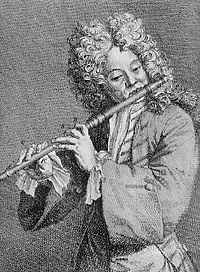
Jacques Martin Hotteterre, the author of
the first method book for the baroque flute, Principes de la flûte traversière
(1707)
Hotteterre
page  |
Michlel Blavet begins a brilliant career
as a soloist in Paris (1726). |
|
|
|
|
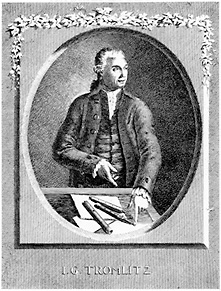
Leipzig virtuoso Johann George Tromlitz,
a soloist famous for his powerful tone and perfect intonation, publishes
a massive flute tutor (1791).
Tromlitz
page |
|
| |
German musicians discover the transverse
flute in the 17-teens. Composers including G.P. Telemann and J.S. Bach contribute
works in a distinctive style to the growing repertoire for the flute. |
|
Frederick the Great becomes King of Prussia in 1740, appointing
C. P. E. Bach as his keyboard player and enticing his flute teacher Quantz
to leave Dresden and become Music Director in Berlin.
Quantz page |
|
Fife and drum bands are now 'traditional'
in German and English military music. They appear in the American Colonies
during the Seven Years' (French and Indian) War. |
Military woodwind ensembles and orchestras begin featuring
flutes more frequently, though not regularly. |
|
|
|
Flutes
made in four sections instead of the usual three begin to be made,
dividing the body between the two hands. Extensions from D to low C also
enjoy a brief vogue.
|
J.J.
Quantz begins building a series of instruments for himself and Frederick
the Great to his own special design, adding a second key to make enharmonic
distinctions more accurately.
Tuning
and intonation page
|
London woodwind maker John Just Schuchart begins building flutes with
additional keys for Bb, G#, F, and an extension from D to low C.
Flute making
technology article |
|
German flute makers are by now building keyed fltes as well as the one-keye
type, usually to low D only. |
In 1785 Tromlitz
invents an instrument with 7 keys. In 1800 he publishes a tutor for
an 8-keyed Tromlitz flute. |