| 1800 |
1810 |
1820 |
1830 |
1840 |
1850 |
1860 |
1870 |
1880 |
1890 |
| Dulon and Louis Drouet are famous virtuosos. Touring
flutists bring different styles of playing to all parts of Europe. Concertos,
fantasies, and variations are popular forms. |
|
Enthusiasm for the flute becomes something like a
mania in Europe, particularly in England. |

Charles Nicholson (1795-1837), the most prominent English
virtuoso of the early 19th century.
|
Symphony orchestras now regularly
include flutes as well as a full brass section. String sections become larger,
and all instruments are playing louder. But mixed wind bands of the military
type are much more common, and provide most of the employment and musical
training for professional flutists. Concertos are unknown, and solo performance
by flutists becomes rare. |
Moritz Fürstenau's pupils at Dresden and
Leipzig conservatories play Bach sonatas at examinations. But elsewhere,
baroque music is forgotten. |
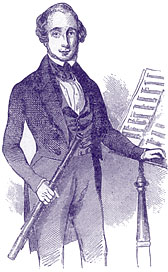
Joseph Richardson (1814-1862, another popular London
soloist (Nicholson and Siccama flutes)
|
Emil Prill (1867-1940) of Berlin takes up the Boehm
flute (1882). |
 |
|
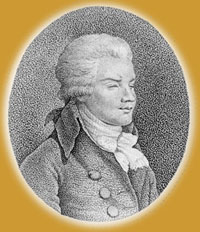
The blind virtuoso Friedrich Ludwig Dülon (1769-1826),
perhaps the first travelling flutist to be thought of as a 'great artist'.
|
Charles Nicholson (1795-1837) moves to
London from Liverpool and becomes popular as a soloist 1816-36. |
|
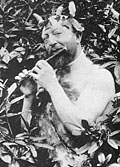
Adolphe Hennebains (1862-1914) as the goatherd-god, Pan. |
| |
Theobald Boehm (1794-1881) gives up his goldsmith's
business to beceome a flute virtuoso. Opens a flute making workshop in 1826. |
Boehm's ring-key flute is officially adopted
at the Brussels Conservatoire. But players in other places, including Fürstenau
in Saxony and Tulou, Professor at the Paris Conservatoire, dislike its tone
and feel it sounds too much like a trumpet. The first Boehm flutes made
in America c1844. |
 |
1860: Louis Dorus (1812-96) introduces the Boehm
flute at the Paris Conservatoire and Louis Lot (1807-96) becomes its official
supplier of flutes. Silver flutes become popular in Paris.
|
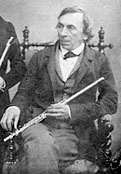
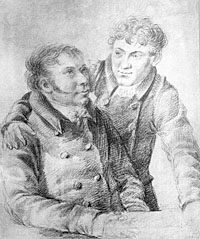
Theobald Boehm (1794-1881)
|
Debussy's orchestral
tone poem Prélude à l'après-midi d'un faune gives the flute a new
musical personality in 1894 with Georges Barrère (1876-1944) playing its
solo flute part.
|
| In Vienna, Georg Bayr develops a flute
with an extended lower range (1813), probably used in early performances
of Beethoven, Kuhlau, Schubert, Weber . . . |
The flutist Caspar Fürstenau (1772-1819) and his son
and pupil Anton Bernhard (1792-1852), himself the father and teacher of
Moritz Fürstenau (1824-89).
|
Baptiste Sauvlet serves in Bilse's concert orchestra,
Berlin, 1873-76, followed by other French and German Boehm flutists. 1879:
Roman Kukala introduces the Boehm flute in Vienna. |
|
William S. Haynes (1864-1939) and his
brother George making Boehm flutes in Boston (1888). |
|
Classical flutes
page 
|
More about Viennese flutes on the 19th-century
flutes page
|
Charles Nicholson is playing a special type of flute with large fingerholes.
Its most comfortable key is Eb major. 19th-century
flutes page
(See also Folk flutes page
)
|
Theobald Boehm, on hearing Nicholson play in London, devises a new flute
design, followed by his conical-bored ring-key flute (1832). Several French
flutists take an interest in it in 1838.
Boehm flute page
|
In 1847 Boehm revises his ring-key flute and produces the first metal
cylinder flute.
Boehm flute page
|
1853 Heinrich Friedrich Meyer (1814-1897) begins building 12-keyed flutes
used in German orchestras and bands. 19th-century
flutes page
|
On Jean-Louis Tulou's retirement from the Paris Conservatoire, the Boehm
flute is made the official instrument of that institution.
|
|
Schwedler & Kruspe model 1885, the first 'Reform' type flute, a conical-bored
keyed flute meant to preserve the sound German orchestral players preferred
to that of the Boehm flute. 19th-century
flutes page
|